
Why Muffin Pans?
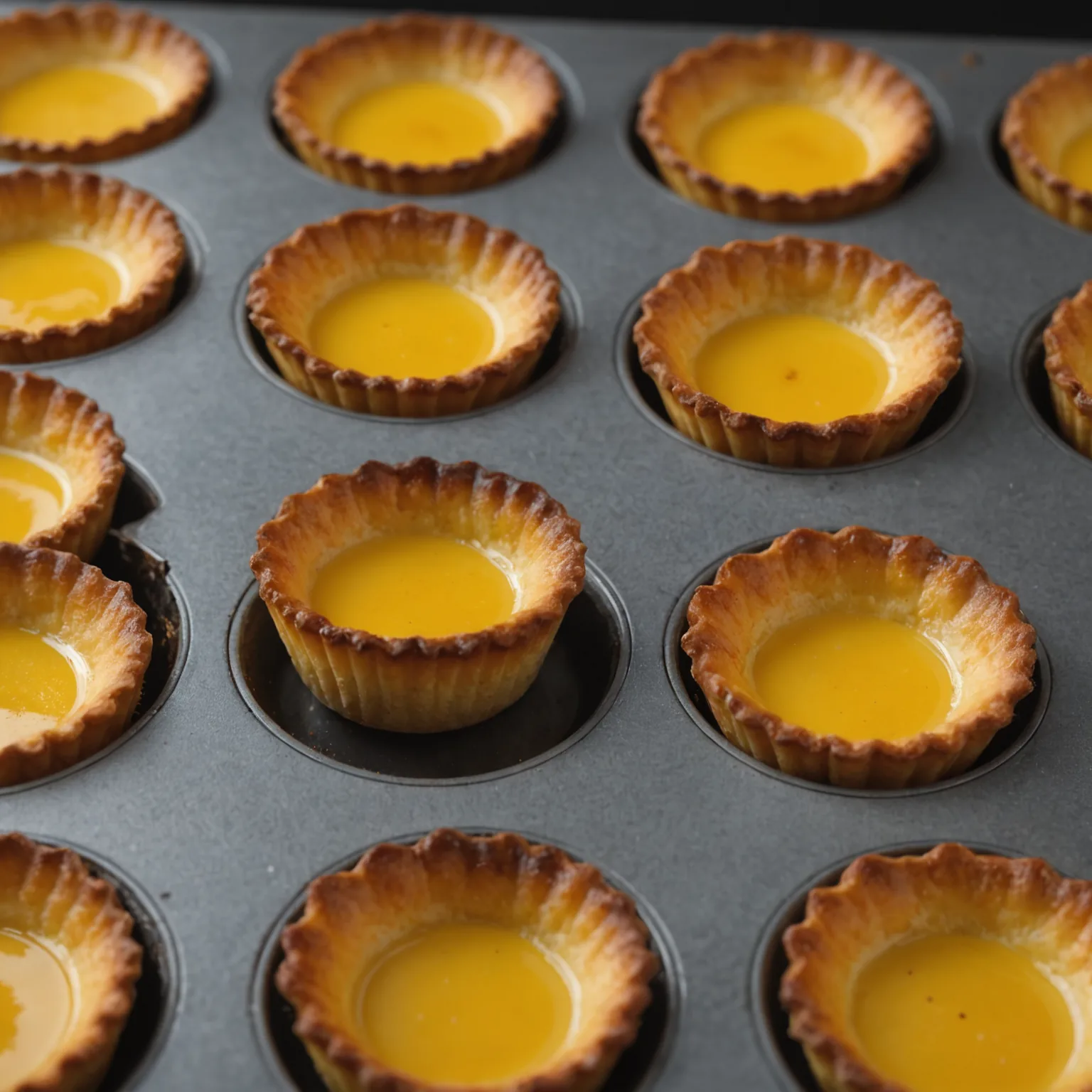
These Portuguese-inspired custard tart cups capture the blistered, caramelized tops and shattering layers of traditional pastéis de nata, reimagined for a standard muffin pan. A quick laminated puff pastry base hugs a silky lemon-cinnamon custard that bakes into golden, freckled rounds that lift cleanly from the tin.
Ingredients
- 1 sheet (8-9 oz) Frozen puff pastry sheet, thawed
- 1 cup Granulated sugar
- 1/3 cup Water
- 1 stick (about 3 inches) Cinnamon stick
- 1 strip (about 3 inches) Lemon peel strip (Yellow part only, avoid white pith if possible)
- 1 cup Whole milk
- 3 tbsp All-purpose flour
- 1/8 tsp Kosher salt
- 4 Large egg yolks
- 1 tsp Pure vanilla extract
- 1/8 tsp Ground cinnamon (Optional, for dusting after baking)
- 1 tbsp Nonstick cooking spray or unsalted butter (Softened, for greasing muffin pan)
Instructions
- 01Preheat the oven to 500°F with a rack in the upper third. Lightly grease a standard 12-cup muffin pan with nonstick cooking spray or softened unsalted butter, making sure to coat the bottoms and sides of each well.
- 02Make the sugar syrup: In a small saucepan, combine the granulated sugar, water, cinnamon stick, and lemon peel strip. Set over medium heat and cook, swirling occasionally, until the sugar dissolves and the mixture comes to a gentle boil. Continue boiling without stirring for 2-3 minutes, just until slightly thickened but still clear. Remove from the heat and let the syrup cool while you prepare the custard base. Leave the cinnamon stick and lemon peel in the syrup to infuse.
- 03Make the milk-flour base: In a separate medium saucepan off the heat, whisk together the all-purpose flour and kosher salt. Gradually whisk in the whole milk, a little at a time, until completely smooth with no lumps.
- 04Cook the milk mixture: Place the saucepan with the milk mixture over medium heat. Cook, whisking constantly, until it thickens to a smooth, pudding-like consistency that lightly coats the back of a spoon, 3-5 minutes. Remove from the heat and let cool for 5 minutes, whisking occasionally to keep it smooth.
- 05Prepare the egg mixture: In a medium bowl, whisk the large egg yolks until smooth. Slowly drizzle the slightly cooled milk mixture into the yolks, whisking constantly, to temper them and prevent scrambling.
- 06Finish the custard: Strain the cooled sugar syrup through a fine-mesh sieve directly into the egg-milk mixture, discarding the cinnamon stick and lemon peel. Whisk until fully combined, then whisk in the pure vanilla extract. The custard will be fairly thin and pourable. Set aside while you shape the pastry cups.
- 07Shape the puff pastry: Unfold the thawed puff pastry sheet on a lightly floured surface, smoothing out any creases. Starting from one short end, roll the pastry up tightly into a log, creating a spiral. Using a sharp knife, cut the log crosswise into 12 equal rounds.
- 08Form the tart cups: Working with one round at a time, place a pastry round cut-side up in a muffin cup. With your thumbs, press and stretch the dough outward and up the sides of the well, keeping the spiral pattern on the bottom and forming an even shell that reaches just to the rim. Repeat with the remaining pastry rounds to line all 12 muffin cups.
- 09Fill with custard: Give the custard a quick whisk, then pour it into each pastry-lined muffin cup, filling each about 3/4 full. Divide the custard evenly among all 12 cups; you should use all of it.
- 10Bake the tart cups: Place the muffin pan on the upper oven rack. Bake at 500°F for 15-20 minutes, rotating the pan halfway through, until the pastry is deeply golden, the custard is puffed with dark caramelized spots on top, and the centers still wobble slightly when the pan is gently shaken.
- 11Optional broil for extra blistering: If the tops are not as freckled as you like but the pastry edges look done, switch the oven to broil and broil the tart cups for 1-2 minutes, watching closely, until the custard tops develop additional dark spots. Do not walk away; they can go from perfect to burnt quickly.
- 12Cool and finish: Transfer the muffin pan to a wire rack and let the tart cups cool in the pan for 10-15 minutes; the custard will set as they cool. Run a thin knife around the edges if needed, then gently lift each tart cup out of the pan. Dust lightly with the optional ground cinnamon just before serving, if desired. Serve warm or at room temperature.
Chef's Notes
The tight spiral of rolled puff pastry mimics traditional Portuguese dough, giving you those flaky, layered sides that really show off the muffin-cup shape. Press the dough up the sides firmly so it doesn't slump down as the fat melts. High heat is non-negotiable for proper blistering; if your oven doesn't reach 500°F reliably, preheat a sturdy baking sheet and set the muffin tin on top to boost bottom heat. Watch through the door instead of opening it repeatedly so the temperature stays steady. The custard should still wobble slightly in the center when you pull them; overbaking leads to a curdled, grainy interior. If the tops aren't spotting but the edges look done, switch briefly to broil for 1-2 minutes, watching like a hawk. Store leftovers in the fridge and re-crisp in a 400°F oven for 5-7 minutes. The texture won't be quite as ethereal as fresh, but the muffin-shaped cups will hold together beautifully and the pastry will regain some of its shatter.
Behind the Scenes
How This Recipe Was Made
Follow the creative team's conversation as they developed, photographed, and published this recipe.
Mon
Tue
Wed
Thu
Fri
Sat
Sun
Margaret
Head Baker
Marcus
Copywriter
Steph
Project Manager
Julian
Art Director
Devon
Site Architect
Ria
Social Media Manager
Portuguese custard tarts in a muffin pan. We're doing it.
That's the hook right there - crispy edges, custardy center, twelve perfect portions you can grab with one hand.
That's not the hook - the hook is that the pan's walls give you structural support while the custard sets, so you get clean edges without a mold. The grab-and-go part is just a bonus.
Fair - the structural thing is actually what makes it work visually. Clean edges mean the caramelization reads on camera, and that's what stops the scroll.
Yeah, the caramelization detail is key - that's the visual story we're actually telling, not just that it fits in a pan.
The caramelization is the narrative arc - it's what transforms custard from filling into something with texture and character, which means the copy has to earn that visual payoff, not just describe it.
Marcus is right - but we need the copy short enough that people actually read it before they hit play, so the visual does the heavy lifting once they're watching.
Fine. But if you're going to lean on the caramel, make sure the pastry gets enough time in the oven - rushed shells won't hold the custard weight.
The shells need low, steady heat to set properly - that's where the pan's geometry actually matters, because the walls trap warmth and give you an even bake that a loose tart shell never gets. Copy should lead with that.
Trays cooled overnight - custard set properly this time. We need to lock ratios before anyone starts improvising.
Good catch on the overnight set - that's the move that makes these actually hold their shape in the pan, which matters for a handheld format where structure is everything.
Yeah, that's exactly it - if the custard's set firm overnight, you can actually grab one without it falling apart in your hand, which is the whole point of the muffin pan format here.
The pastry walls need to be thick enough to support the weight, or you're just eating custard soup out of a collapsed shell.
The custard needs to be dense enough that it doesn't weep or separate overnight - if we're going that route, we might need to dial back the liquid ratio slightly or add an extra yolk for richness and stability.
What if we just commit to the extra yolk and see what happens - I'm curious if that alone gets us there without cutting liquid?
Just got the tarts out of the light box. Three totally different reads on these - macro detail, flat lay geometry, and the broken-open hero. Ready to talk through which one actually lands.

Which one shows the lamination best? That's what I keep coming back to - the custard matters but so does knowing there's actual work inside.
The macro shot of the custard filling works if you can see the lamination shadow in the background - that's the one that tells the actual story.
The broken-open hero shows the lamination clearest - you can see the actual layers when it's split, and that's what makes people stop to understand what they're looking at.
Agreed - the split tart is the move because you're actually seeing the labor, not just inferring it. I'll shoot the broken one with side rake light to catch those layer shadows.

The gaps are going to read as shadows at that angle - make sure you're actually lighting INTO the layers, not just across them.
I think the side rake actually risks flattening what we just figured out - what if you come in from underneath to catch the depth between each layer?
Morning, all. Got the pastry sheets thawed, got the copy half-written, got coffee going - let's lock this down. I'm thinking the title should be "Caramelized Custard in a Muffin Pan" but I'm open to pushback.
That title tells me nothing - why would anyone make this instead of just buying one at the bakery?
You're right - that's lazy. What if we lead with the technique instead? "Crispy Custard Tarts from Frozen Puff" - it signals you're doing something real with store-bought sheets, which is honestly the whole point.
The frozen sheet angle works - shows restraint instead of pretending we made the dough from scratch like some food blog.
Need to see the custard fill before we lock the title - if it's got that caramel color and depth, that's the actual visual hook, not the puff.
Alright. Let's look at what we're shipping. Pasteis de Nata - the custard ratio locked in yet, or are we still guessing?
Ratio's locked, staging's live, one broken image link I'm fixing right now.
The image link matters less than whether the copy actually lands - I need to see the full package before we call this done.
Copy's solid - he knows what he's doing. Just make sure the caramelization notes don't oversell it. Those cups brown fast and people will panic.
Yeah, that's fair - I'll have Marcus dial back the caramelization language so people don't think they've burned it when it's actually perfect.
The shots need to lead - if the progression isn't visible, the copy won't save it no matter how good it is.
The shots are there - I checked the progression myself this morning. If people can't see the custard setting, that's on composition, not on us.
Margaret's right - the progression is there, and I've pulled back the panic language on the browning. Copy's ready to ship. Good week.
Morning. Portuguese custard tarts staging - should be straightforward.
Staging's up now, running through verification.
Verification catches the cinnamon ratio - too heavy in the filling, it'll overpower the custard by the time they bake.
Pulled the ratio back - custard reads cleaner now, cinnamon's just background.
Good call pulling it back. Custard needs to be the star here. Page looks clean - I'm done.
Morning everyone - we're live soon. Last check on everything before we push this out?
Yeah, we're good - pulling Margaret's pull-out shot for the feed first, then the cross-section for stories. Caption's ready to go.
The captions look right - short enough that people will actually read them, which is its own small miracle. I'm calling it. See you all tomorrow.